
Are Saint Bernards Good With Kids? A Practical Family Guide

Saint Bernards can be good with children, but a calm breed reputation is not a safety guarantee. Individual temperament, training, supervision, and the children’s behavior matter. Their enormous size makes even friendly excitement something a household must manage carefully.
A Saint Bernard can suit a family willing to provide patient training, realistic space, and clear boundaries. Choosing one because they are described as a “nanny dog” sets the wrong expectation: an adult still needs to supervise every interaction.
Why families consider Saint Bernards
The breed is commonly described as affectionate, patient, and people-oriented. A settled adult may enjoy being close to the family without wanting nonstop activity. Those tendencies explain the breed’s appeal, but puppies and adolescent dogs can be energetic and clumsy.
The AKC Saint Bernard breed profile describes the breed’s general character. Use a profile to frame questions, then judge the actual dog you are considering.
Meeting an individual dog and discussing their history is more informative than relying on a label. Ask how they behave around children moving, shouting, carrying food, and approaching resting places.
Size changes the practical picture
A dog this large can knock a child over while greeting, turning, or following a toy. That does not require aggression. Doorways, stairs, and narrow spaces may need extra management during busy family routines.
Teach four paws on the floor and a calm place to settle. Adults should handle the leash and moving the dog when necessary. A young child should not be responsible for physically controlling a giant dog.
Make sure the home has enough room for the dog to lie down without becoming an obstacle. A dog’s resting spot should not sit in the middle of a child’s main play route.
Set rules for both dog and children
- Let the dog eat and chew in a separate, undisturbed area.
- Do not climb on, hug tightly, ride, or pull the dog’s coat.
- Leave a sleeping dog alone.
- Invite the dog to approach instead of following them into a corner.
- Stop interaction when either participant becomes excited or uncomfortable.
These rules apply even to a dog that has always appeared tolerant. Tolerance should not become an expectation that the dog must accept everything.
For first introductions, use our guide to meeting a dog without overwhelming them. A quiet greeting and the freedom to move away are especially useful when a large dog and a small child are getting acquainted.
What active supervision looks like
An adult needs to be close enough and attentive enough to interrupt early. Watching from another room or scrolling through a phone while children wrestle nearby is not meaningful supervision.
Notice if the dog turns away, repeatedly leaves, becomes still, or avoids contact. End the interaction rather than asking the child to try harder to make friends. Growling is a warning to respect, not behavior to punish away.
When an adult cannot watch, use suitable gates or separate rooms. The dog should have a comfortable resting area where children do not follow.
Train useful household skills
Start reward-based training early, while the dog is easier to manage physically. Practice coming when called, settling on a mat, walking calmly, and waiting at doorways. Keep sessions short and consistent across family members.
Teach the children what they can do: toss a reward to a designated spot with adult guidance, help prepare a supervised enrichment game, or quietly sit while the dog chooses whether to approach. Do not assign them training tasks that depend on strength.
Exercise should suit the dog’s age, condition, and weather. A garden alone does not provide a complete routine, and a Saint Bernard should not be expected to keep up with every high-energy child’s activity.
Questions before bringing one home
Ask the breeder or rescue about observed child interactions, handling comfort, and any history of guarding belongings. For an adult rescue, ask what is known and what remains uncertain.
Also consider transport, grooming, drool, cleaning, and the cost of supplies sized for a giant dog. If your family needs a lightweight playmate a child can walk independently, those requirements may point elsewhere.
Are they suitable for toddlers?
Some households manage this successfully, but toddlers cannot reliably follow all dog-handling rules. Separation and close adult supervision become especially important. Choose based on the individual dog and the adults’ ability to manage daily life, rather than the hope that a gentle reputation will solve the risks of size.
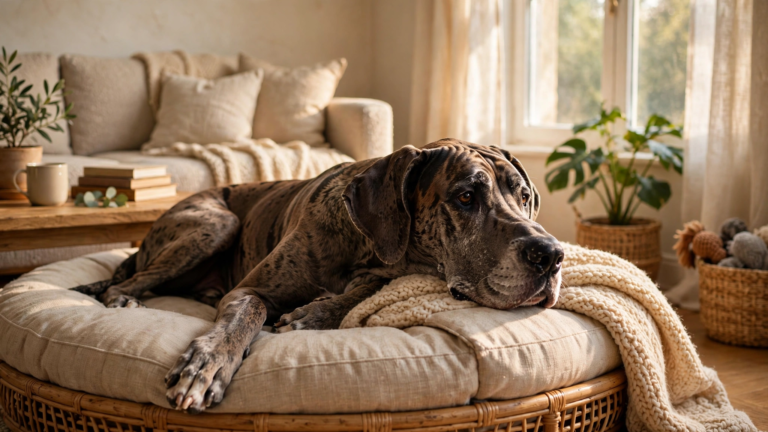
Featured photo: Vlad Rudkov / Unsplash.






3 Comments
Comments are closed.