How to Get a Dog Urine Sample: A Step-by-Step Guide
The Short Answer
To get a dog urine sample at home, take your dog out on a leash at a time they usually pee (first thing in the morning is best), and slide a clean, shallow container under them mid-stream. Transfer it to the sterile cup your vet provided, label it, refrigerate it, and deliver it within a few hours. It takes practice, but most owners get it on the first or second try.
Why Your Vet Wants a Urine Sample
A urinalysis is one of the most useful — and least invasive — diagnostic tools in veterinary medicine. Your vet may ask for a sample to check for urinary tract infections, bladder stones or crystals, kidney disease, diabetes, or Cushing’s disease. It is also used to monitor dogs already being treated for these conditions. A “free catch” sample collected by you at home is the least stressful option for everyone: no clinic visit, no needle, no catheter — just you, your dog, and a container.
What You Will Need
- A clean, shallow container. A disposable foil pie tin, a clean plastic food container with a low rim, or a dedicated ladle all work. Shallow and wide beats deep and narrow — you need to slide it under quickly without startling the dog.
- The sterile cup from your vet. Most clinics will hand you a proper specimen cup with a lid. If they did not, ask — collecting directly into the final container is ideal.
- Disposable gloves. For your hygiene and to keep the sample clean.
- A leash. Keeps the dog close and prevents the classic chase-around-the-yard scenario.
- A label and pen. Dog’s name, your name, date, and time of collection.
- Optional: a ladle taped to a stick. The famous “ladle on a yardstick” trick gives you reach without looming over a shy dog. Duct-tape a clean ladle to a ruler or dowel.
Wash and rinse your collection container thoroughly before use, and let it dry completely — soap residue can skew results. Never use a container that held chemicals, sugary foods, or cleaning products.
Male vs. Female Dogs: Different Techniques
Leg-lifters and squatters need different approaches. For adult males who lift a leg, collection is straightforward: position yourself slightly to the side and hold the container in the stream’s path — most males are so focused on marking that they barely notice you. Tall dogs are the easiest of all.
Females, puppies, and males that squat go low and fast, which makes timing trickier. A wide, flat container is essential — a deep cup simply will not fit under a small female. The ladle-on-a-stick method was practically invented for this scenario: you get reach without crouching over the dog and triggering her to stop. With very shy females, try the first morning pee when the stream is longest, and consider having a helper hold the leash while you focus on the container.
Step-by-Step: Collecting the Sample
- Time it right. The best moment is the first pee of the morning, when the urine is most concentrated and the bladder is fullest. Knowing how long after drinking water your dog usually needs to pee helps you predict the moment instead of guessing.
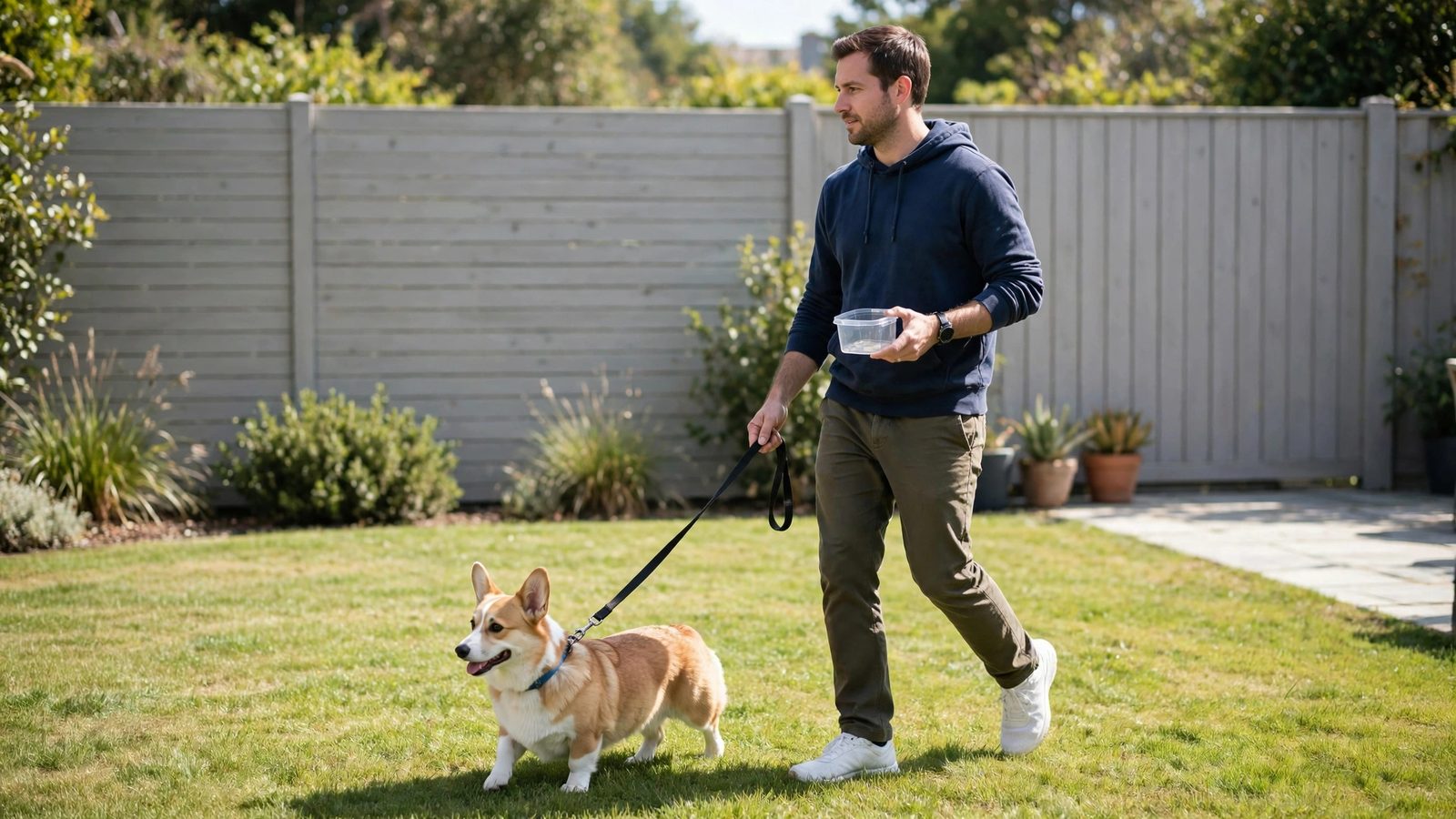
- Leash up and head to the usual spot. Dogs prefer familiar ground. Keep the leash short enough that the dog cannot wander off mid-squat.
- Act natural. Do not hover or stare at your dog’s hindquarters — many dogs will simply stop if they sense they are being watched. Stand relaxed, look bored, and have the container ready in your hand.
- Let them start, then slide in mid-stream. Wait a second or two after the stream begins (this “midstream” portion is cleaner, having flushed the lower urinary tract), then smoothly slide the container under. Be quick but calm — jerky lunges spook dogs.
- Adjust for males vs. females. Males who lift a leg are the easiest: hold the container near the stream’s arc. Females and squatting males go low and fast, so a flat, wide container (or the ladle-on-a-stick) works best. For very small females, first-morning attempts on a short leash give you the best odds.
- Transfer and seal. Pour the urine into the vet’s sterile cup, seal the lid tightly, and wipe the outside. You only need a tablespoon or two — even a teaspoon can be enough for basic tests, so do not despair over a small catch.
- Label immediately. Dog’s name, date, and exact time. Labs process dozens of samples; unlabeled ones cause real problems.
- Refrigerate and deliver promptly. If you cannot get to the vet within an hour or two, refrigerate the sample. Most clinics accept samples up to 12 hours old if kept cold, but fresher is always better — bacteria multiply and crystals dissolve as urine sits.
Troubleshooting: When Your Dog Will Not Cooperate
- The dog stops the moment you approach. This is the most common problem. Switch to the ladle-on-a-stick for distance, or try again tomorrow — many dogs relax about it on the second attempt once they realize nothing bad happens.
- The dog will not go with you watching. Give them more leash, turn half away, and pretend to check your phone. Privacy matters to some dogs.
- You keep missing. Try the first-morning pee when the stream is longest and most predictable. Some owners have luck collecting from male dogs against a favorite marking spot like a fence post.
- Nothing works after several tries. Call your vet. They can collect urine in the clinic via cystocentesis (a quick, ultrasound-guided bladder tap with a thin needle) or catheterization. It sounds dramatic but is routine, fast, and gives the cleanest sample of all.
For a vet-authored walkthrough with photos of the techniques, this veterinarian’s illustrated guide to collecting pet urine samples is an excellent companion to these steps.
What NOT to Do
- Do not collect urine from a puddle on the ground or a pee pad — contamination makes results unreliable.
- Do not squeeze or press on your dog’s belly to force urine out. It is stressful and can cause injury.
- Do not use containers with soap residue, food remnants, or chemical traces.
- Do not leave the sample at room temperature for hours and expect accurate results.
- Do not stress if you only get a small amount — bring what you have and let the vet decide if it is enough.
Frequently Asked Questions
How much urine does the vet need?
Less than you think. A tablespoon or two (15–30 ml) is plenty for a standard urinalysis, and even a teaspoon can work for basic dipstick tests. If your vet needs a larger volume for culture, they will tell you — or collect it themselves.
Can I collect the sample the night before the appointment?
It is better to collect the morning of the appointment. If you must collect the night before, refrigerate the sample immediately and tell the vet exactly when it was collected. Samples older than 12 hours, or left warm, can give misleading results.
Why does my vet want a “first morning” sample?
Morning urine is the most concentrated, having sat in the bladder overnight. Concentration matters for detecting dilute-urine conditions like kidney disease or diabetes. If mornings are impossible, any fresh sample is better than none — just note the time.
My dog only pees on walks, not in the yard. How do I collect it?
Bring your kit on the walk. The leash keeps the dog close, and the ladle-on-a-stick shines here — you can reach under without breaking stride or crowding the dog. Many owners find walk collection easier than yard collection because the dog is focused on sniffing, not on you.
Is a home-collected sample as good as one taken at the vet?
For most routine screening, yes. A midstream free catch is perfectly valid for urinalysis. The vet-collected cystocentesis sample is “cleaner” (bypasses the lower urinary tract) and is preferred for bacterial culture, but your home sample is ideal for the initial check — which is usually all that is needed.
Can I use a home urine test strip instead of going to the vet?
Over-the-counter pet urine test strips can flag obvious issues like glucose or blood, and some owners use them for monitoring between vet visits. But strips do not replace a laboratory urinalysis — they cannot do microscopy, culture, or precise concentration measurements. If a strip shows anything abnormal, or if your dog has symptoms, the vet visit is still necessary.
The Bottom Line
Collecting a dog urine sample sounds awkward, but it is a simple skill: right time, shallow container, midstream catch, label, refrigerate, deliver. Pair it with a predictable morning potty routine and you will rarely have to chase the moment. And if your dog outsmarts you three mornings running, let the vet take over — that is literally what the clinic is for.