Palm Up or Down When Approaching a Dog? The Safer Answer
Quick answer: Palm up or down when approaching a dog? Modern trainers say neither — do not thrust your hand at an unfamiliar dog at all. Let the dog approach you, and if you offer anything, make it a relaxed loose fist or the back of your hand held low, below the dog’s chin. The old “palm up means friendly” advice is outdated, and a hand in the face can startle even a nice dog.
Where the Palm-Up Advice Came From
For decades, well-meaning advice columns and even some dog-bite-prevention sites taught a simple rule: approach with your palm facing up. The logic sounded reasonable — an open, upturned palm cannot grab, so it supposedly signals “I mean no harm,” while a palm-down hand hovering over the head looks like a strike about to land.
The advice stuck because it is easy to remember and it feels actionable. Many people still teach it to their kids. But it was built on human logic, not dog logic. Dogs do not read palm orientation the way we imagine. What they actually react to is a hand moving toward their face — sudden, looming, and inside their personal space. Whether that hand is palm-up or palm-down matters far less than the fact that it is coming at them.
Why Modern Trainers Disagree With Both Options
Certified behaviorists and fear-free trainers have largely moved past the palm debate for three reasons:
- Dogs do not need your hand to smell you. A dog’s nose detects scent from several feet away. Pushing your hand under their nose is for your comfort, not theirs.
- Reaching triggers defense. A hand extending toward the face — up, down, or sideways — can look like the start of a grab, especially to shy, fearful, or undersocialized dogs. Many bites happen exactly in this moment.
- It skips consent. The safest greetings in the animal world are the ones the animal chooses. A dog that walks up to investigate you has opted in; a dog you reach toward has not.
That does not mean you can never offer your hand. It means the hand comes last, low, and only after the dog has shown interest — not first, at face height, as an opening move.
What the Dog’s Body Language Is Telling You
Before your hand does anything, your eyes should do the work. A dog that wants to meet you looks loose and wiggly: soft eyes, relaxed open mouth, body curving in a loose C-shape, tail wagging in wide sweeps at a neutral height.
Back off and give space if you see any of these:
- Stiff, frozen body or hard stare
- Tail tucked tight, or held high and stiff with short rapid wags
- Ears pinned flat, lip licking, yawning, or turning the head away
- Showing the whites of the eyes (“whale eye”)
- Growling, barking, lunging, or backing away
Remember that every dog is an individual. Even temperament differences between male and female dogs of the same breed can change how a dog greets strangers, and confident guardian breeds like German Shepherds and Belgian Malinois may be naturally warier of unfamiliar people than a social retriever. Read the dog in front of you, not the breed stereotype.
The Safest Way to Greet an Unfamiliar Dog
Follow this sequence and you will be safer than any palm orientation could make you:
- Ask the owner first. “May I say hello to your dog?” If the answer is no — or hesitant — respect it cheerfully.
- Turn slightly sideways. A side-on posture is far less confrontational than facing the dog head-on.
- Soften your gaze. Avoid direct staring; glance at the dog, then look slightly away. In dog language, a hard stare is a challenge.
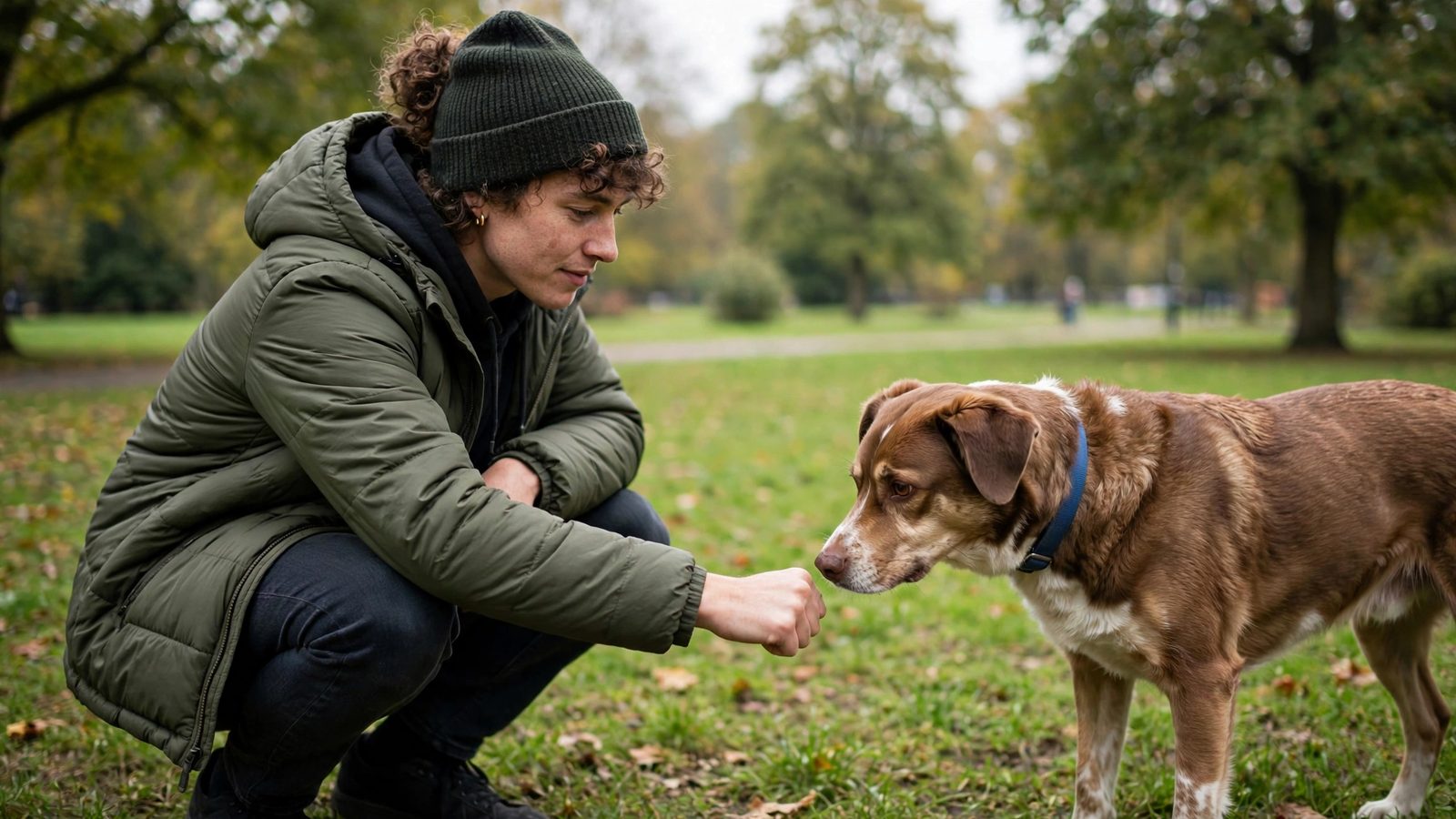
- Crouch or kneel. Make yourself smaller, but do not loom over the dog or bend at the waist above them.
- Let the dog come to you. Stay still and calm. Give them time — some dogs need a full minute to decide you are safe.
- Offer a low, loose fist if they approach. A loosely closed hand is compact and unthreatening; the dog can sniff your knuckles without fingers wiggling near their eyes. Hold it low, below chin level, and keep it still.
- Pet the chin, chest, or side — never the top of the head. Reaching over the head is the single most common greeting mistake. If the dog leans in, a few seconds of chin scratches is plenty.
- Use the 5-second rule. Pet for five seconds, then stop and see if the dog asks for more. A dog that nudges your hand or leans in is opting in; a dog that moves away is done.
For the full rundown of warning signs and safe habits, ASPCA’s dog bite prevention guide is an excellent reference to bookmark.
Reading Consent: Green Lights vs. Red Flags
Think of every greeting as a conversation where the dog gets veto power:
- Green lights: dog approaches you, soft wiggly body, nudges your hand, leans against your leg, play bows.
- Yellow lights: dog sniffs and freezes, looks away, licks lips — pause, give space, let them re-approach.
- Red lights: dog moves away, growls, shows teeth, stiffens — interaction over, no exceptions.
Teaching yourself to stop petting the moment a dog disengages is the most important greeting skill there is. Most dogs do not bite “out of nowhere” — they bite after a string of ignored yellow lights.
What About Kids?
Children are bitten more often than adults, usually by familiar dogs during everyday interactions. Teach kids the same sequence in simple language: ask the owner, be a tree (stand still, arms at sides), let the dog come to you, gentle pets on the chest only. Never let a child hug an unfamiliar dog, put their face near the dog’s face, or chase a dog that walks away. Supervise every interaction — no exceptions, no matter how “good” the dog is.
Greeting Mistakes That Get People Bitten
Most dog bites during greetings follow the same handful of errors. Avoid all of them:
- Reaching over the head. The number-one mistake. A hand descending from above looks like a strike even when you mean a pat.
- Hugging. Dogs do not hug each other; being wrapped up feels like being trapped. Save hugs for dogs who explicitly invite them.
- Cornering the dog. A dog with no escape route may choose “fight” when “flight” is unavailable. Always leave them a clear path away from you.
- Squealing and fast movements. High-pitched excitement amps dogs up. Keep your voice calm and your body slow.
- Staring into their eyes. Sustained direct eye contact reads as a challenge. Soft glances, then look away.
- Ignoring the owner. The owner knows whether their dog is friendly, fearful, in training, or reactive. Their “no” is final.
Notice what all of these have in common: they are about what the human does, not the dog. Greeting safely is almost entirely a human skill.
Frequently Asked Questions
Should I put my hand out for a dog to sniff?
Only after the dog has chosen to approach you. Standing calmly with your hands relaxed lets the dog gather your scent without a hand thrust into their space. If you do offer your hand, keep it low, still, and loosely closed.
Is it ever okay to pet a dog on top of the head?
With your own dog who loves it, sure. With a dog you just met, no — reaching over the head reads as threatening. Start under the chin or on the chest and let the dog guide you.
What should I do if an unfamiliar dog approaches me?
Stand still, stay quiet, avoid direct eye contact, and let the dog sniff. Most dogs investigate and move on. Do not run, scream, or shove the dog away.
Why do dogs dislike being reached for?
A reaching hand is fast, looming, and aimed at their most vulnerable area — the face. Dogs that were grabbed, hit, or roughly handled in the past are especially sensitive to it, but even well-socialized dogs prefer to initiate contact.
Does palm orientation matter at all?
Marginally. If you must extend your hand, palm-up-and-low or a loose fist is slightly less threatening than palm-down-over-the-head. But the far bigger factors are asking permission, letting the dog approach, and reading their body language.
Conclusion
Palm up or down when approaching a dog is the wrong question — the right question is whether your hand should be reaching out at all. Ask the owner, make yourself small and non-threatening, let the dog come to you, and keep any hand you offer low, still, and brief. Dogs are excellent communicators; when you let them lead the greeting, palm orientation stops mattering entirely.