Best Anti Bark Device for Dogs: 2026 Buyer’s Guide
The best anti bark device for dogs depends on where and why your dog barks — but here is the honest summary: ultrasonic tabletop devices like the PetSafe Indoor Bark Control work well for indoor nuisance barking, handheld ultrasonic trainers like STOPWOOFER are best for on-the-go correction, and no device replaces training. Devices suppress barking; only training plus management address why the dog is barking in the first place.
This guide compares the main device types, names the top picks for 2026, and covers the safety concerns most roundup articles skip.
The 4 Types of Anti-Bark Devices
1. Ultrasonic tabletop/box devices
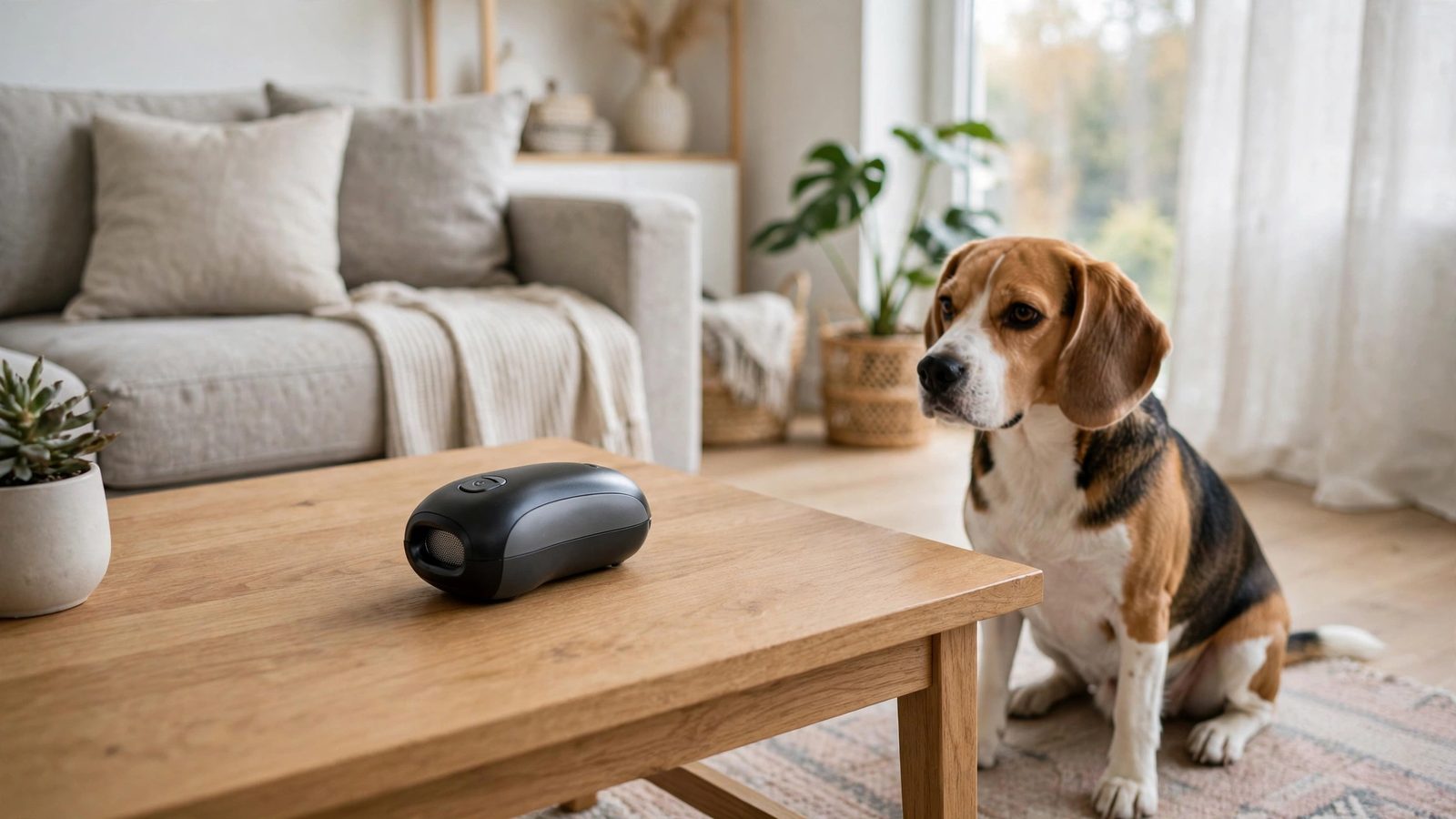
These sit in a room and emit a high-pitched tone (around 25 kHz, inaudible to most humans) when their microphone detects barking. Range is typically 25 to 50 feet — about one or two rooms. Best for: dogs that bark when home alone or at window triggers. Limitation: they cannot distinguish your dog’s bark from the TV or a neighbor’s dog, and some dogs habituate to the sound within weeks.
2. Handheld ultrasonic trainers
Button-activated devices you aim at the dog, effective to about 15-25 feet. Best for: interrupting barking on walks or training the “quiet” cue. They require you to be present and consistent — the device is only as good as the training behind it.
3. Bark collars (vibration/beep)
Worn on the neck, these start with a beep or vibration and escalate if barking continues. Best for: persistent barkers when the owner cannot supervise. Concern: in multi-dog households, one dog can be corrected for another dog’s bark, and static models can cause fear and anxiety.
4. Citronella spray collars
Release a burst of citronella scent when the dog barks. Milder than static, but refills cost money, and some dogs learn to bark through the spray or empty the canister for fun.
If you want to understand the mechanism first, read how anti-bark devices work — it explains the ultrasonic, vibration, and spray principles in plain language.
Top Picks for 2026
Best for indoors: PetSafe Indoor Ultrasonic Bark Control
The most recommended tabletop unit across review sites. Automatic or manual activation, 25-foot range covering one to two rooms, runs on a 9V battery for months. Simple to use: place it where the dog barks most. Downside: no on/off switch (you remove the battery), and some dogs learn to ignore it.
Best handheld: STOPWOOFER Ultrasonic Trainer
Pocket-sized, rechargeable (2-hour charge lasts about two weeks), 25 kHz tone with a 16-foot range, plus an 8-second auto shutoff to protect hearing. Good for walks and training sessions. Less effective on very large or highly aroused dogs.
Best budget: Zelers Rechargeable Mini Bark Control
Box-style unit with a 50-foot detection range, four sensitivity levels, and a rechargeable battery lasting about a month. Can be hung on a fence or wall for outdoor use. A solid pick if you want maximum coverage for minimum money.
Best collar (no static): vibration/beep bark collar
Look for models that start with tone, add vibration, and reset to the lowest level automatically. Avoid cheap static collars with no safety cutoff — the correction should never be the loudest thing in the dog’s life.
Do Anti-Bark Devices Actually Work?
They work as interrupters: the unpleasant or surprising stimulus breaks the barking cycle in the moment. Studies and trainer experience agree on the limits:
- Habituation is common. Many dogs stop reacting to ultrasonic tones within weeks if nothing else changes.
- They don’t teach an alternative. The dog learns “barking is unpleasant” but not what to do instead — which is why pairing the device with “quiet” cue training matters.
- Anxiety-driven barking gets worse. A dog barking from separation anxiety or fear that gets startled by a device can become more anxious, not quieter.
- Wrong-dog corrections happen. Automatic devices in multi-dog homes can punish the quiet dog for the noisy one’s behavior.
The American Kennel Club’s position is worth hearing: bark deterrents work through positive punishment, carry risks to the dog’s mental health, and are no more effective than positive-reinforcement methods. The AKC’s advice on curbing excessive barking recommends understanding the cause first and consulting a certified trainer before reaching for any device.
The Training-First Approach (Use With Any Device)
- Find the trigger. Doorbell? Passersby? Boredom? A device aimed at boredom-barking is a bandage — the dog needs exercise and enrichment instead.
- Manage the environment. Close blinds, use white noise, block window access. Removing triggers beats correcting reactions.
- Teach “quiet.” Let the dog bark two or three times, say “quiet” calmly, then reward the instant of silence. Build duration gradually.
- Reward silence proactively. Catch your dog being quiet around former triggers and pay generously. This is the behavior you actually want.
- Use the device as backup. If you use one, pair every activation with the “quiet” cue so the dog learns the rule, not just the startle.
For the most common indoor trigger of all, our doorbell barking training plan walks through desensitization step by step.
Safety Rules
- Never use any device on puppies under 6 months, deaf or hearing-impaired dogs, or dogs with seizure disorders.
- Never use a device as punishment — it is an interrupter paired with training, not a remote scolding machine.
- If barking is sudden, new, or paired with other behavior changes, see your vet first. Pain and cognitive decline cause vocalization that no device should suppress.
- Supervise bark collars; check the neck daily for irritation.
Anti-Bark Device Buyer’s Checklist
Before you spend money, run through these eight checks:
- Know the trigger. If you can’t name why the dog barks, a device is a guess. Boredom, fear, and alert barking need different solutions.
- Match the type to the location. Indoor chronic barking → tabletop box. Barking on walks → handheld. Barking when unsupervised → collar.
- Check the range honestly. Manufacturers measure range in open air. Walls, furniture, and wind cut real-world range significantly.
- Look for auto-shutoff. Any ultrasonic device should stop after several seconds of continuous activation to protect hearing.
- Prefer rechargeable. Devices that eat 9V batteries get expensive and tend to get abandoned in a drawer.
- Read the 2-star reviews. Five-star reviews tell you it worked once; two-star reviews tell you about habituation, false triggers, and build quality.
- Plan the training pairing. Decide now which cue (“quiet”) you’ll teach alongside the device. A device without a training plan is just a noisemaker.
- Set a trial period. Give it two to three weeks of consistent use. If barking hasn’t meaningfully decreased, the device isn’t the answer — the diagnosis is wrong.
A Note on Multi-Dog Households
Automatic bark devices deserve extra caution when you have more than one dog. Ultrasonic boxes and bark collars can’t reliably tell which dog barked, so the quiet dog may get corrected for the noisy one’s behavior — which is confusing and unfair. If you have multiple dogs, handheld manual devices (where you choose the moment) or training-first approaches are far safer than automatic ones. When in doubt, train the barkers individually before introducing any shared device.
FAQ
Are ultrasonic bark devices safe for dogs?
Yes, when used as directed. The tone is startling, not painful, and quality devices include auto-shutoff to prevent overexposure. They are not recommended for very young puppies, senior dogs with hearing loss, or epileptic dogs.
Will an anti-bark device stop my neighbor’s dog from barking?
Outdoor-rated box devices with 50-foot ranges are marketed for this, but results are mixed — distance, fences, and wind reduce effectiveness. Talking to your neighbor usually works better than technology.
Do dogs get used to anti-bark devices?
Many do. Habituation is the most common complaint in long-term reviews. Rotating the device’s mode (if it has multiple) and pairing it with active training slows this down.
Are bark collars cruel?
Static shock collars carry the most welfare concerns and are opposed by many veterinary behaviorists. Vibration/beep collars are milder but still aversive. Positive training methods achieve the same results without the fallout, which is why trainers recommend trying them first.
Conclusion
The best anti bark device for dogs is the one matched to your situation and paired with real training: a tabletop ultrasonic unit for indoor barking, a handheld for walks, and a training plan underneath it all. Buy the device if you want, but invest most of your effort in the “quiet” cue, trigger management, and exercise. That combination quiets barking for good instead of just interrupting it.