How Do Ultrasonic Dog Barking Deterrents Work?

The Short Answer
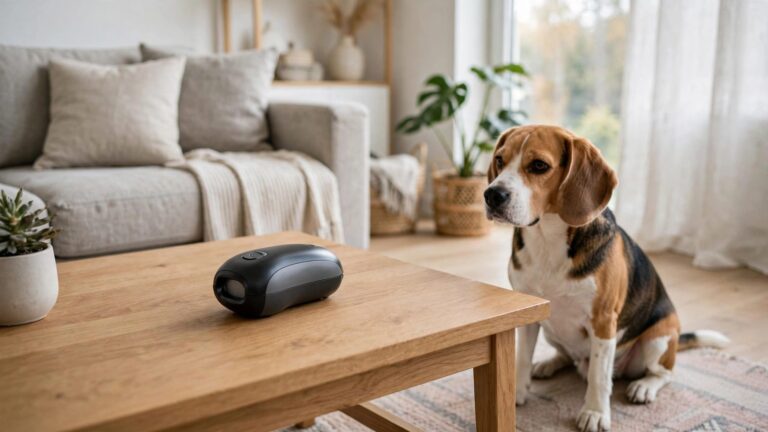
Ultrasonic dog barking deterrents work by emitting a high-frequency sound (around 25,000 Hz) that dogs can hear but humans cannot. A built-in microphone detects barking and triggers the tone, which is designed to be unpleasant enough to interrupt the bark. The sound stops when the barking stops, so the dog theoretically learns that silence turns off the noise. In practice, results are inconsistent: some dogs stop barking, many ignore the devices entirely, and sensitive or anxious dogs can become stressed or fearful. They are not a substitute for training that addresses why the dog is barking.
How Ultrasonic Bark Deterrents Work: The Science
Dogs hear far better than we do. Human hearing tops out around 20,000 Hz; dogs hear from roughly 67 Hz up to about 45,000 Hz. Ultrasonic deterrents exploit that gap by producing tones in the ~25 kHz range — silent to you, audible (and, manufacturers claim, irritating) to your dog.
The mechanism is a simple loop:
- Detection: a microphone in the device picks up the sound of barking.
- Emission: the device instantly emits the ultrasonic tone, sometimes paired with a flashing LED or vibration.
- Interruption: the sudden unpleasant sound startles or annoys the dog mid-bark.
- Association: over repetitions, the dog is supposed to connect barking with the annoying tone and quiet with relief.
It is a form of positive punishment (adding an aversive stimulus) — not pain-based like a shock collar, but aversive by design. The tone only works with a clear line of sight: high-frequency sound waves dissipate quickly and are easily blocked by walls, furniture, and even heavy outdoor obstacles.
Types of Ultrasonic Bark Deterrents
Handheld Devices
Small, remote-like units you point at the dog and trigger manually (or that trigger automatically). Best for walks and indoor training moments. Range is typically up to 50 feet, and they require you to be present and paying attention.
Stationary Indoor/Outdoor Units
Box-shaped devices placed in a yard or room that listen continuously and fire automatically when they detect barking. Outdoor models claim ranges up to 300 feet and are often marketed for silencing a neighbor’s dog — a use fraught with its own problems (see below).
Ultrasonic Bark Collars
Worn on the dog, triggered by throat vibration or sound. These follow the dog everywhere, which also means the dog can never escape the correction — a significant welfare concern for anxious dogs.
A Note on “Silent” Dog Whistles
Galton-style dog whistles operate on the same principle — an ultrasonic tone only dogs hear — but as a cue rather than a punishment. Trainers use them to signal recall or other commands at a distance. The difference matters: a whistle paired with rewards builds behavior, while a deterrent’s tone is designed to be unpleasant enough to suppress behavior. Same physics, opposite training philosophy.
Do They Actually Work? What the Evidence Says
Honestly: sometimes, for some dogs, for a while. There is no robust body of peer-reviewed research proving consistent effectiveness, and what studies exist show variable results. Here is what determines the outcome:
- The individual dog. Bold, confident barkers may be briefly startled and then habituate — they simply learn to bark through it. Sound-sensitive or anxious dogs may shut down, which looks like “working” but is actually fear.
- The cause of barking. A dog barking from boredom might be interrupted; a dog barking from separation anxiety or territorial arousal is driven by powerful emotions a beep cannot resolve. Unaddressed, the underlying need finds another outlet — often a worse behavior.
- Placement and environment. If the device cannot “see” the dog, or the dog is beyond effective range, nothing happens. Owners cannot hear the tone, so they cannot verify the device is even functioning.
- Habituation. Many owners report the device works for a week or two, then the dog tunes it out — the same pattern seen with citronella collars.
Our own take aligns with most veterinary behaviorists: these devices are an unreliable shortcut. If you want to understand the broader category, our guide on how anti-bark devices work compares ultrasonic units with the other options on the market.
Risks and Humane Concerns
- Stress and anxiety: the tone is designed to be unpleasant. In nervous, noise-sensitive, or already-anxious dogs it can increase fear, trigger avoidance behaviors, and even worsen the very barking it is meant to stop.
- Collateral damage in multi-pet homes: every animal in range hears the correction — including the quiet, well-behaved dog lying in the corner and potentially cats. Punishing innocent animals is both unfair and confusing.
- You cannot verify what your dog experiences: because the sound is inaudible to you, you have no way to know if the device is working, misfiring, or blasting continuously due to a stuck sensor.
- It punishes communication: barking is how dogs communicate. Suppressing it without addressing the cause — fear, boredom, alerting, attention-seeking — is like putting tape over a smoke alarm.
- Neighbor-dog use is ethically dubious: aiming an aversive device at someone else’s dog, whose behavior history and temperament you do not know, can cause real distress to an animal you cannot observe.
Better Alternatives That Actually Work
Teach “Quiet” on Cue
The most direct replacement: train an incompatible behavior. When your dog barks, wait for a natural pause, say “quiet,” and reward the silence generously. Build duration gradually. Unlike a gadget, a trained cue works everywhere and strengthens your bond instead of eroding trust.
Figure Out Why They Are Barking
Doorbell barking, for example, is usually arousal + territorial instinct — and it responds beautifully to desensitization and a trained alternative behavior. Our doorbell barking training plan walks through exactly that process. Separation-anxiety barking needs a gradual alone-time protocol; boredom barking needs more exercise and enrichment.
Meet the Underlying Need
A tired dog is a quiet dog. Many “problem barkers” are simply under-exercised or under-stimulated. A solid daily routine of physical exercise, sniff walks, puzzle feeders, and training games eliminates a huge fraction of nuisance barking with zero gadgets.
Manage the Environment
Block visual triggers (frosted window film is magic for fence-line barkers), use white noise to mask outside sounds, and do not reward demand barking with attention. Management is not cheating — it is smart training.
Get Professional Help
If barking is intense, sudden in onset, or paired with anxiety or aggression, skip the gadgets and consult a certified professional dog trainer (CPDT-KA) or veterinary behaviorist. They will diagnose the cause instead of just muting the symptom.
Frequently Asked Questions
Are ultrasonic bark deterrents safe?
They do not cause physical pain like shock collars, but “not painful” is not the same as “harmless.” The main risks are psychological: stress, anxiety, and fear, especially in sensitive dogs. They are also indiscriminate in multi-pet homes.
Can humans hear ultrasonic dog deterrents?
No — that is the point. The ~25 kHz tone sits above the ~20 kHz upper limit of human hearing. This is also why you cannot tell whether the device is working properly.
Do ultrasonic deterrents work on all breeds?
No. Effectiveness varies enormously by individual temperament and hearing sensitivity, not just breed. Deaf or hearing-impaired dogs will not respond at all, and determined barkers of any breed often habituate within weeks.
Are ultrasonic bark collars humane?
Most veterinary behaviorists urge caution. While less severe than shock collars, they still apply an aversive the dog cannot escape, and they are frequently used without addressing the underlying cause of barking. Positive-reinforcement training is the welfare gold standard.
What is the best alternative to a bark deterrent device?
Training a “quiet” cue combined with addressing the root cause — exercise, enrichment, desensitization, or professional help for anxiety-driven barking. It takes longer than unboxing a gadget, but the results are reliable and lasting.
Conclusion
Ultrasonic barking deterrents work exactly as advertised on paper: they detect barking and emit a high-frequency tone dogs find unpleasant. In the real world, though, they are unreliable, they can stress sensitive dogs, they punish every animal in earshot, and they do nothing about why the dog is barking. If you are tempted by one, try the alternatives first: train “quiet,” meet your dog’s exercise and enrichment needs, and get professional help for tough cases. Your dog — and your conscience — will be better off. The few minutes of real training each day pays off for the rest of your dog’s life, with none of the welfare question marks. For the AKC’s own overview of bark-control tools and their trade-offs, see their guide to bark control tools.