
Leaving Puppies Alone While at Work: What Really Works

Yes, you can have a puppy and a job — millions of people do it successfully. The honest catch is that a young puppy cannot simply be left for a full workday: an 8-week-old needs the toilet every hour or two and shouldn’t be alone for more than about an hour at first. The solution is a bridge plan: a safe setup at home, a midday break of some kind, and alone time that grows gradually as your puppy’s bladder and confidence grow. Here is how to put that together, week by week.
How Long Can a Puppy Be Left Alone? Limits by Age
The widely used rule of thumb is one hour per month of age, up to a sensible ceiling. Bladder capacity is only half of it — young puppies also need frequent meals, social contact, and reassurance while their brains develop.
- Under 10 weeks: about 1 hour maximum
- 10 to 12 weeks: up to 2 hours
- 3 months: up to 3 hours
- 4 months: up to 4 hours
- 5 months: up to 5 hours
- 6 months and older: up to 6 hours; most adult dogs top out at 6 to 8 hours with a midday break built in
These are ceilings, not targets — and they assume your puppy has been gradually prepared, not dropped into a full day alone on day one. For a deeper look at the numbers at one common age, see how long you can leave a 4-month-old puppy alone.
Setting Up a Safe Space for the Workday
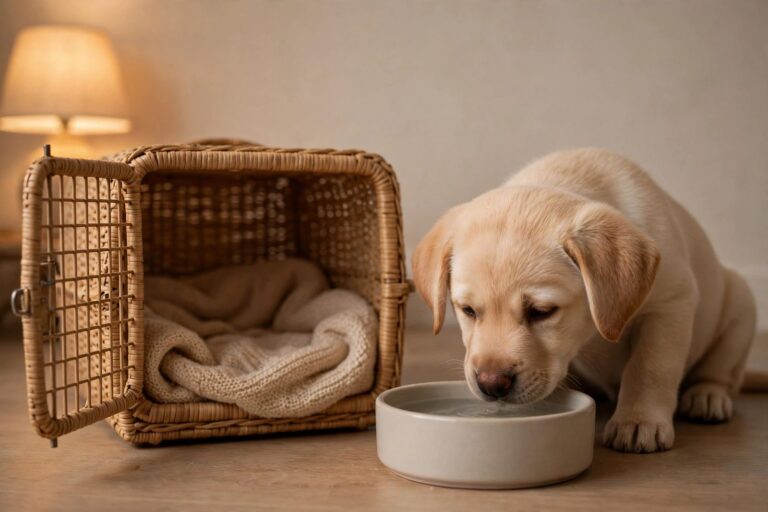
Where your puppy waits matters as much as how long. A whole house is too much freedom for a young puppy; a bare crate for hours is too little. The sweet spot for work hours is usually a playpen or one puppy-proofed room, set up like this:
- A crate or bed in one corner for sleeping, door open, so rest is a choice.
- A toilet area as far from the bed as possible — a pee pad or grass patch — since a puppy left longer than they can hold it needs a legitimate option that won’t wreck your house-training.
- Fresh water in a heavy, spill-proof bowl.
- Safe occupation: chew toys, a stuffed frozen Kong, a snuffle mat. Nothing with small parts, strings, or anything that can splinter or be swallowed unsupervised.
- Nothing dangerous in reach: cables, cleaning products, medications, shoes, and houseplants all move out. Puppies investigate the world mouth-first.
- A worn T-shirt of yours in the bed — your scent is genuinely calming.
Bridging the Gap: Midday Break Options
Until your puppy is around 6 months old, a full workday needs at least one midday break. You have more options than you might think, and many owners combine two or three across the week:
- Come home at lunch. The gold standard if your commute allows: toilet break, quick play, fresh water, back to work. Even 20 minutes transforms the day.
- A dog walker or pet sitter. A 30-minute midday visit covers the toilet, a meal, and human contact. Choose insured walkers, meet them first, and leave written instructions.
- A trusted neighbor, friend, or family member. Retired neighbors and older kids home from school are often delighted to help — sometimes the cheapest and happiest arrangement of all.
- Doggy daycare. Excellent for socialization and burning energy, but only once vaccinations are complete (usually after 16 weeks) and usually for a half or full day, one to three times a week rather than daily.
- Staggered schedules. If you live with a partner or housemate, offsetting start times by even an hour at each end shrinks the alone window significantly.
- Work-from-home days or a phased return. Taking leave or remote days in the first two weeks makes the whole transition dramatically easier.
Planning the whole routine on paper helps enormously — our walkthrough of a puppy schedule designed for full-time workers shows what a realistic day looks like hour by hour.
Using a Camera to Check In
A basic pet camera is one of the best purchases a working puppy owner can make. It tells you the truth about how your puppy is coping: most puppies, once settled, sleep the majority of the day away — genuinely useful peace of mind. Watch for the difference between brief whining that settles within minutes (normal) and sustained pacing, howling, drooling, or escape attempts (a problem to address). Use two-way talk sparingly; some puppies find a disembodied voice more unsettling than silence. Many owners find that checking the camera at set times — late morning and mid-afternoon — beats constant monitoring, which tends to raise the human’s anxiety more than the puppy’s.
Building Alone Time Gradually
Alone time is a skill, and it is trained, not assumed. Start before your first workday back:
- Practice departures at home. Step out for 2 minutes, then 5, then 15, several times a day, keeping arrivals and departures completely low-key — no big hellos or goodbyes.
- Feed meals and special chews in the alone space while you are still home, so the pen predicts good things, not just your absence.
- Run errands of increasing length over the first week or two, using the camera to confirm your puppy settles.
- Only stretch the time when the current length is boring. If your puppy naps through 2 hours happily, try 2.5. If they are still restless at 1 hour, they are not ready for more.
The First Two Weeks Back at Work
Treat your return like a training program, not a leap. In week one, keep absences at the short end of your puppy’s age range, use your most reliable midday arrangement every day, and watch the camera footage honestly: a puppy who cries for five minutes and then sleeps for two hours is doing fine. Expect a few toilet accidents in the pen during this period even from a puppy who is clean when you are home — that is bladder capacity, not defiance or spite, and it resolves as the weeks pass. In week two, stretch each absence slightly if the footage shows a settled puppy. By the end of the fortnight most owners have a realistic picture of what their puppy can handle, which midday option works best, and whether anything — a bigger pen, a different walker time, a radio left on — needs adjusting. Resist changing everything at once; tweak one variable at a time and give it a few days.
A Sample Workday Schedule
- 6:00 am: Wake up, toilet, breakfast, play and a short training game
- 7:30 am: Final toilet trip, settle in the pen with a frozen Kong, you leave
- 12:30 pm: Midday break — toilet, lunch meal, play, fresh water
- 1:00 pm: Settle again with a safe chew
- 5:30 pm: Home — toilet first, then a proper walk, play, and dinner
- Evening: Family time, short training, last toilet trip around 10:30 pm
Signs Your Puppy Is Not Coping
Some struggling is normal in week one. Take these seriously if they persist: howling or barking for most of your absence, drooling or panting heavily on camera, destructive chewing focused on doors and exits, toilet accidents from a puppy who holds it fine when you are home, or a puppy who shadows you frantically whenever you are in. These are early separation anxiety signs, and they respond best to help early — a certified trainer or your vet can build a proper desensitization plan. The AKC’s advice on having a dog while working a 9-to-5 covers the same ground, including when daycare or a walker is the right call.
Frequently Asked Questions
Can I leave an 8-week-old puppy alone for 8 hours?
No. An 8-week-old can hold their bladder for about an hour and needs feeding and company far more often than that. A full workday at this age requires a midday break at minimum — ideally two — or someone staying with the puppy.
Is it better to use a crate or a playpen while I am at work?
For short absences, a crate is fine if your puppy is crate trained. For work-length stretches, a playpen or puppy-proofed room with a toilet area is kinder and more practical, since no young puppy can hold it for hours.
Will leaving my puppy alone cause separation anxiety?
Not if it is introduced gradually and kept within your puppy’s age-appropriate limits. Puppies who are left too long, too soon, with no preparation are the ones at risk — which is why the build-up plan matters.
Should I get a second dog to keep my puppy company?
Not as a fix for a work schedule. Two puppies are double the training, and littermate syndrome is a real risk. Get your first puppy settled and trained; a companion can come later for the right reasons.
The Bottom Line
Leaving puppies alone while at work works when three things line up: the alone stretches respect your puppy’s age, a midday break bridges the long gap until about 6 months, and the time alone has been built up gradually with a safe, comfortable setup. Do that, and your puppy will mostly spend your workday doing what puppies do best — sleeping through it.




One Comment