When Do Puppies Stop Excited Peeing? An Age Guide
Most puppies stop excited peeing between 6 and 12 months of age, once their bladder muscles mature and the world feels a little less overwhelming. A few sensitive dogs keep dribbling during greetings until 18 months, and that can still be normal. What matters most in the meantime is how you respond: calm greetings, an empty bladder before visitors arrive, and absolutely no punishment. This guide walks through the age-by-age timeline, how to tell excitement peeing apart from submissive peeing, and the signs that point to a vet visit instead of more training.
When Do Puppies Stop Excited Peeing? The Age-by-Age Timeline
Excited peeing is a developmental stage, not a house-training failure. Your puppy’s bladder sphincter — the muscle that holds urine in — is still weak, and a surge of emotion simply overpowers it. As that muscle strengthens and your puppy’s emotional regulation improves, the leaks fade. Here is the typical progression:
- Under 12 weeks: Leaks are almost guaranteed during greetings, play, and even being picked up. Bladder control is minimal at this age, and everything is thrilling.
- 3 to 6 months: Most puppies improve noticeably. Accidents still happen at peak moments — you walking through the door, a favorite guest arriving — but calm, everyday play usually stays dry.
- 6 to 12 months: This is when the majority of puppies stop excited peeing for good. Bladder capacity grows, and greetings stop feeling like the best moment of their entire life.
- 12 to 18 months: Late bloomers, giant breeds, and very soft, sensitive puppies may still dribble occasionally. As long as it is steadily decreasing, it is usually just maturity arriving on its own schedule.
- Adults over 18 months: Occasional excitement leaks in a young adult can be a personality trait, but frequent or new-onset leaking deserves a vet check (more on that below).
Why Puppies Pee When They Get Excited
When a puppy gets excited, adrenaline floods their system, their heart rate climbs, and their abdominal muscles tense — all of which puts pressure on a bladder they can barely control in the first place. The result is an involuntary dribble, often while the puppy is mid-wiggle and completely unaware it is happening. Small breeds tend to leak more simply because their bladders are tiny, and puppies raised in busy, stimulating environments may take longer to settle. None of this is defiance, and none of it means your house training is failing. Your puppy is almost certainly dry the rest of the day; this one reflex is just the last piece of physical control to come online.
Excited Peeing vs. Submissive Peeing: Telling Them Apart
These two look similar — small amounts of urine during interactions — but they come from opposite emotions and need slightly different handling. The body language gives it away:
Excited peeing comes with a loose, wiggly body, a fast-wagging tail held high or mid-level, jumping, spinning, and bright, engaged eyes. It happens during greetings, play, and leash time — the happiest moments of the day.
Submissive peeing comes with a crouched, lowered body, ears pinned back, tail tucked, averted eyes, lip licking, and sometimes rolling onto the back and dribbling. It happens when the puppy feels intimidated: someone looming over them, a loud voice, a hand reaching straight for their head, or being scolded.
Some puppies do both. The fix overlaps — lower the intensity of every interaction — but submissive peeing needs extra confidence-building and a strict no-scolding rule, because fear is driving it. The AKC’s guidance on puppies peeing when excited makes the same point: this is involuntary communication, not misbehavior.
How to Help Your Puppy Outgrow It Faster
You cannot rush muscle development, but you can dramatically cut the number of puddles while you wait. These habits work for both excitement and submissive peeing:
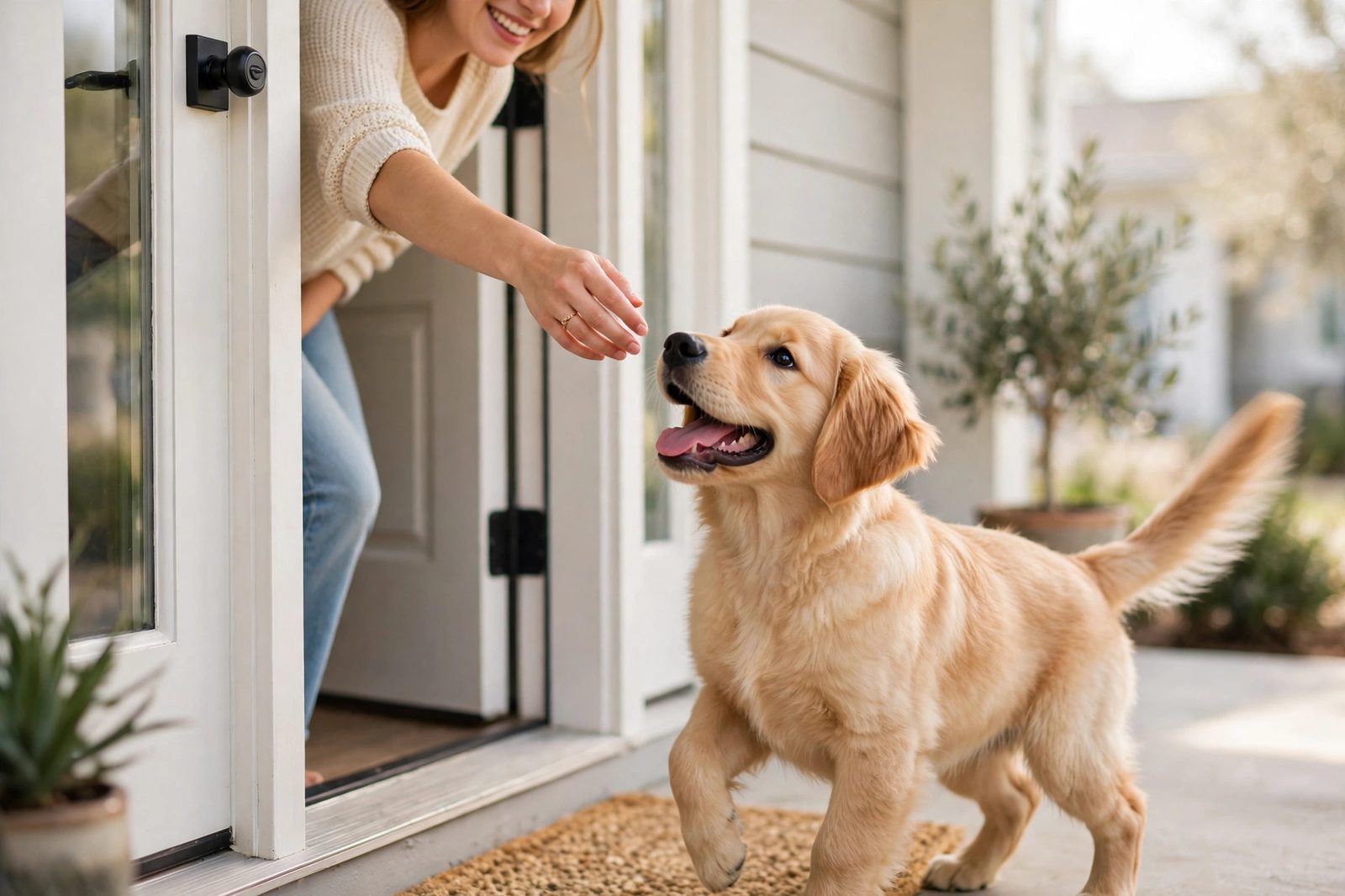
- Make greetings boring. Walk in quietly, put your things down, and ignore your puppy for the first minute or two. No eye contact, no high-pitched voice, no bending over them. Once they settle, crouch sideways at their level and greet them calmly.
- Empty the bladder before exciting events. Take your puppy out for a toilet break right before guests arrive, before play sessions, and the moment you get home — greet outdoors when you can.
- Brief your visitors. Ask guests to ignore the puppy at first and let the puppy approach them, rather than the other way around. Most “guest puddles” disappear within a few visits.
- Reward calm, not chaos. The second your puppy offers a sit or stands calmly during a greeting, mark it with quiet praise or a treat. Building basic skills also helps: structured practice like how to get puppies to listen to you gives your puppy an alternative behavior to offer when emotions spike.
- Never punish a leak. Scolding an excitement pee-er teaches them greetings are scary, which adds submissive peeing on top. Clean up silently with an enzymatic cleaner and move on.
- Build confidence daily. Short training games, gentle exposure to new people and places, and letting shy puppies approach at their own pace all reduce both types of leaking over time.
It also helps to remember the bigger picture of bladder development — the same maturing system governs how long a 4-month-old puppy can be left alone without an accident, and both improve steadily month by month.
When Excited Peeing Is Actually a Vet Issue
Greeting dribbles in a young puppy are normal. The following are not, and each one warrants a vet visit rather than more training:
- Leaking while asleep or resting. A puppy who wakes up in a wet patch is not excited peeing — that is true incontinence and needs investigating.
- Constant dribbling as the puppy walks around, or urine that smells unusually strong or looks cloudy or bloody.
- Straining, crying, or frequent tiny pees — classic signs of a urinary tract infection or bladder stones.
- A sudden increase in drinking and peeing, which can point to metabolic problems even in young dogs.
- A puppy or young dog who has never been fully dry. In young females especially, an ectopic ureter (a birth defect where the urine tube bypasses the bladder) causes lifelong dribbling that only imaging and surgery can fix.
- An adult dog who suddenly starts after being dry for years — new-onset leaking in adults is medical until proven otherwise.
A urinalysis is cheap, quick, and non-invasive, and it rules out the most common culprits. Always rule out the medical side before assuming a behavior problem.
What to Do in the Moment (and Right After a Leak)
Your reaction in the ten seconds after a dribble shapes how fast the habit fades. When it happens, stay neutral: no gasping, no sighing, no laughing and fussing either — big reactions of any kind feed the emotional spike. Quietly lead or carry your puppy outside to their toilet spot, let them finish there if they need to, and praise that calmly. Clean the indoor spot later, out of sight if you can, with an enzymatic cleaner so no scent remains to mark the place as a toilet. If leaks always happen at one predictable moment — the front door, a particular guest, the start of play — treat that moment as your training ground: rehearse it in miniature, at low intensity, a few times a week, rewarding every dry, settled greeting. Owners typically see the frequency drop within two to three weeks of consistent calm greetings, well before the underlying reflex matures completely.
Frequently Asked Questions
Is excited peeing a sign my puppy is not house trained?
No. House training is about knowing where to go; excited peeing is an involuntary reflex that bypasses that knowledge entirely. A puppy can be perfectly house trained and still dribble during a thrilling greeting.
Do some breeds pee when excited more than others?
It is more about size and temperament than breed. Small dogs with tiny bladders and soft, people-pleasing, or sensitive puppies of any breed tend to leak the most, and they may take until 12 to 18 months to fully outgrow it.
Should I limit my puppy’s water to reduce excited peeing?
Never. Puppies need free access to water, and restricting it risks dehydration and urinary problems without fixing the reflex. Manage the greetings, not the water bowl.
My puppy pees when I pick her up. Is that the same thing?
Usually, yes — being scooped up is exciting and the pressure on a full little bladder does the rest. Let her empty her bladder first, crouch to her level before lifting, and keep the lift slow and predictable.
The Bottom Line
When do puppies stop excited peeing? For most, somewhere between 6 and 12 months, with sensitive late bloomers finishing by 18 months. Keep greetings calm, empty the bladder before exciting moments, reward settled behavior, and never punish a leak — and one day soon you will realize the puddles simply stopped. If the leaking happens during sleep, comes with straining or blood, or starts suddenly in an adult, skip the training advice and book the vet.