When Should Puppies Start Drinking Water?

Quick answer: Puppies should start drinking water at about 3 to 4 weeks of age, right when weaning begins. Before that age, mother’s milk (or a proper puppy milk replacer) gives them all the fluid they need. Offer water in a shallow dish next to their first mushy meals, let them explore it at their own pace, and by 6 to 8 weeks most puppies are drinking confidently on their own.
Why Puppies Don’t Need Water in the First Few Weeks
A newborn puppy is built to run on milk alone. Mother’s milk is roughly 80 percent water, so a nursing puppy hydrates every time it feeds, which in the first two weeks of life is every couple of hours. At the same time, a newborn’s stomach is tiny and its kidneys are still maturing, so filling that little stomach with plain water would actually work against the puppy: water has no calories, and every sip of it is a sip of milk — and nutrition — missed.
There is also a practical safety point. Very young puppies cannot regulate how they swallow particularly well, and forcing water into a puppy’s mouth risks it going down the wrong way into the lungs. So for the first three weeks, the rule is simple: milk only, from mom or from a bottle if you are hand-rearing, and no water bowl in the whelping box for puppies to fall into, chill in, or foul.
The exception is illness. A puppy that is not nursing, is losing weight, or seems weak needs a veterinarian, not a dish of water. Puppies dehydrate fast, and a vet can give fluids safely and find out why the puppy is struggling in the first place.
The 3 to 4 Week Window: When Water Enters the Picture
Around three weeks of age, several things change at once. A puppy’s eyes and ears have opened, it is toddling around the box, baby teeth are erupting, and mom starts spending short stretches away from the litter. This is when breeders begin weaning — offering a thin gruel of puppy food softened with warm water or milk replacer — and water comes with it.
The timing is not a coincidence. As solid food gradually replaces milk, the water that used to arrive inside the milk has to come from somewhere else. PetMD’s guide to weaning puppies onto solid food follows the same 3-to-4-week schedule: gruel first, with a small bowl of water offered at feeding times, and free access to water whenever puppies are awake by about 5 to 6 weeks.
Do not be surprised if your 3-week-old mostly ignores the dish, steps in it, or blows bubbles in it. Interest usually starts as play. Actual drinking picks up steadily through weeks 4 and 5 as the milk share of the diet shrinks.
How to Introduce Water, Step by Step
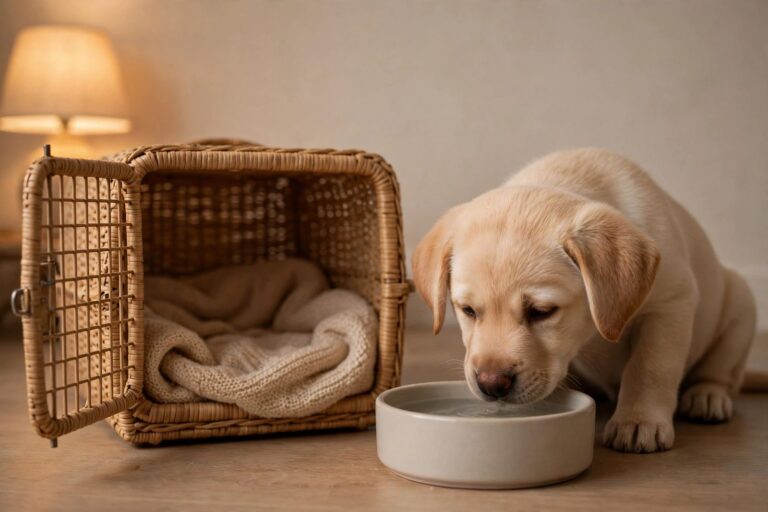
- Choose the right dish. Use a heavy, shallow pan or low-walled dish that a puppy cannot tip over or climb into and get stuck. Pie plates and “flying saucer” puppy pans work well for litters.
- Fill it with clean, room-temperature water. Change it several times a day. Puppies drag bedding, food, and paws through their water constantly.
- Offer it at feeding times first. Set the water dish beside the gruel. Puppies investigating food are in exactly the right place and mood to experiment with drinking.
- Show them it is drinkable. Dip a clean finger in the water and let the puppy lick it, or dab a drop on its lips. Never push a puppy’s face toward or into the water.
- Expect a mess. Walking through the dish, pawing at it, and face-planting are all normal stages of learning. Keep towels under the dish and dry wet puppies promptly so they do not chill.
- Supervise, then make it freely available. Watch early sessions so no puppy gets crowded out or soaked. By 5 to 6 weeks, healthy puppies should have access to water whenever they are awake. If you are mapping out the whole transition, our weaning-age guide to when a puppy can drink water lays out the week-by-week milestones.
How Much Water Should a Puppy Drink?
A widely used rule of thumb is that a healthy dog needs roughly half an ounce to one ounce of water per pound of body weight per day. Growing puppies sit at the higher end of that range because they are more active, are building tissue, and lose moisture faster relative to their size.
In practical terms, that looks like this:
- 3 to 4 weeks: Just sips. Most hydration still comes from milk and the liquid in gruel. Intake is hard to measure and does not need to be — nursing plus offered water is enough for a thriving puppy.
- 5 to 6 weeks: Drinking becomes purposeful. Many puppies this age drink a few tablespoons at a time, several times a day, totaling roughly half a cup to a cup depending on size.
- 8 weeks: A typical puppy drinks around 1 to 1.5 cups a day, with small breeds at the low end and large-breed puppies well above it.
- 3 to 6 months: Intake climbs with body weight — often 1.5 to 2 cups or more — and should roughly track the per-pound rule above.
Diet matters too. A puppy eating dry kibble drinks noticeably more than one eating wet food, which is already about 70 percent water. Heat, exercise, and play sessions all push intake up for a few hours, which is normal. What you are watching for is the overall pattern, not any single drink — and that pattern develops alongside what you can safely feed a puppy during weaning and after.
From 8 Weeks On: Building Good Water Habits at Home
By the time a puppy goes to its new home at around 8 weeks, it should be a competent drinker. Your job is simply to keep fresh water available whenever your puppy is awake and out of the crate. Wash the bowl daily — biofilm builds up fast — and refresh the water at least once or twice a day, more in warm weather.
Overnight is the one time most owners restrict access, and for a healthy, weaned puppy that is fine. Offer a last drink an hour or so before bed, take your puppy out for a final toilet trip, and let it sleep. Puppies do not need a water bowl in the crate overnight, and removing it makes nighttime house training considerably easier. The exception is a sick puppy or very hot conditions — in those cases, follow your vet’s advice.
Signs Your Puppy Is Drinking Too Little — or Too Much
Too little is the urgent direction. Puppies have small reserves and can dehydrate quickly, especially with vomiting or diarrhea. Warning signs include:
- Dry, tacky gums instead of moist and slippery
- Skin that stays “tented” when you gently pinch and release the scruff
- Sunken or dull-looking eyes
- Lethargy, weakness, or loss of interest in feeding
- Dark, strong-smelling urine, or much less urine than usual
Any young puppy showing these signs needs a vet the same day. Do not try to fix dehydration at home with syringes of water unless a vet has shown you how and told you to.
Too much is subtler. A puppy that suddenly drinks constantly, floods the bowl area, and urinates excessively may just be hot or may have eaten something salty — but persistent excessive thirst can also flag problems such as a urinary infection or, rarely, a congenital issue. A single day of heavy drinking after wild play is unremarkable; a new pattern that lasts several days is worth a vet call.
Frequently Asked Questions
Can a 2-week-old puppy drink water?
No — and it does not need to. At two weeks, all hydration comes from milk. The only reason to give fluids to a puppy that young is illness or orphan rearing, and both belong under veterinary guidance.
Should I add water to my puppy’s food?
Yes. Softening kibble with warm water to make a gruel is the classic first step of weaning, and many owners keep softening food for a few weeks because it is gentler on new teeth and adds hydration.
Do puppies need water at night?
A healthy, weaned puppy does not need water overnight. Offer a drink before bed, give a last toilet break, and refill the bowl first thing in the morning.
What if my puppy will not drink from the bowl?
Try a shallower dish, a different material (some puppies dislike metal), a quieter location, and freshly changed water. If a puppy refuses water for more than a few hours — especially with vomiting, diarrhea, or lethargy — call your vet.
Can puppies drink cow’s milk instead of water?
No. Many puppies and dogs cannot digest lactose well, and cow’s milk commonly causes diarrhea, which is the last thing a growing puppy needs. After weaning, plain water is the right drink.
The Bottom Line
Puppies should start drinking water at 3 to 4 weeks of age, alongside their first gruel, in a shallow dish they can explore safely. Intake builds steadily from sips to roughly half an ounce to an ounce per pound of body weight a day, and by 8 weeks a healthy puppy manages its own hydration as long as fresh water is there. Watch the pattern, keep the bowl clean, and let your vet know quickly if drinking drops off or suddenly surges — with puppies, changes in water intake are often the first clue that something else needs attention.