Why Do Dogs Sniff Your Feet? 6 Reasons Explained
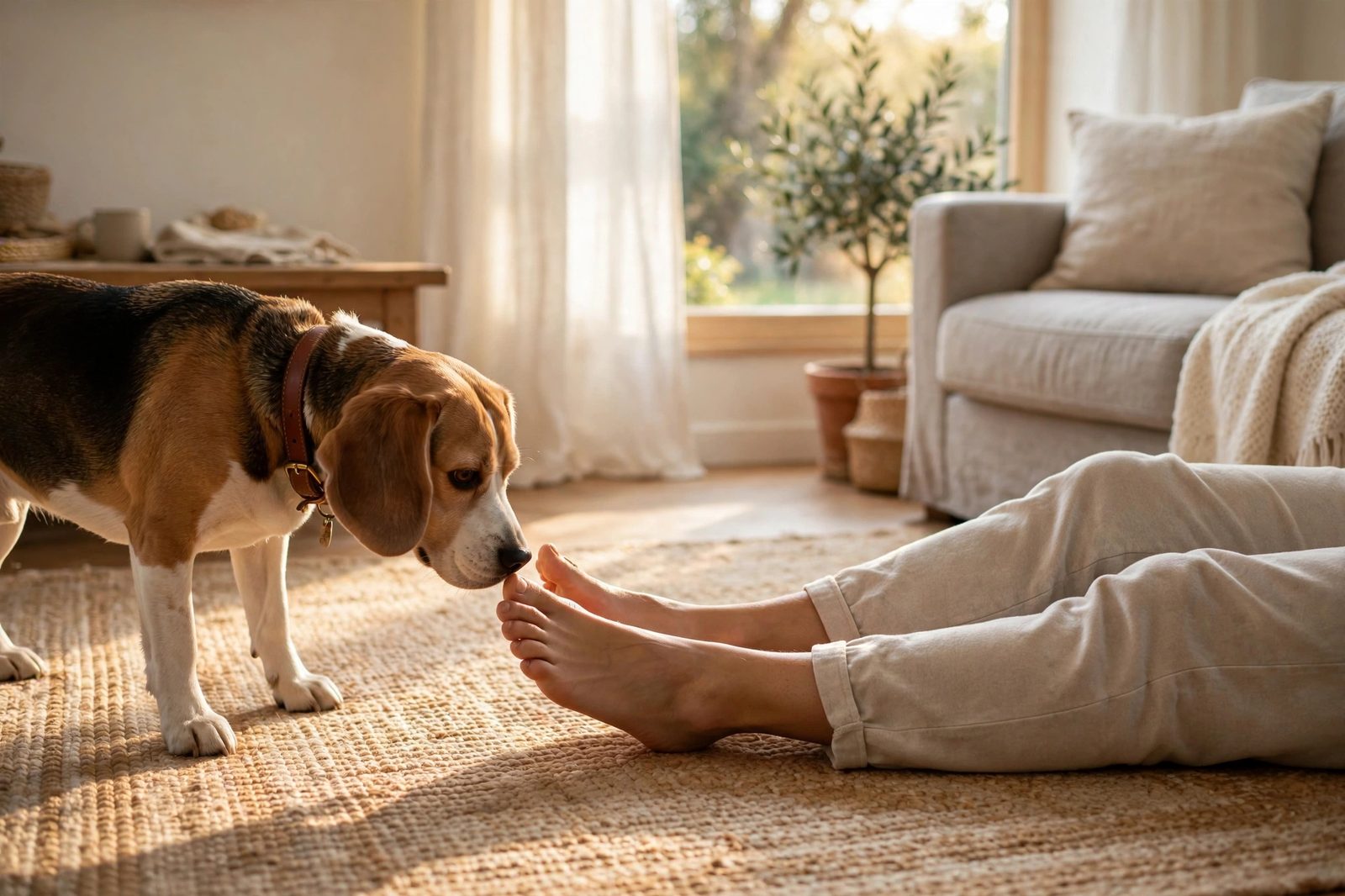
If your dog makes a beeline for your feet every time you sit down, you are not alone. Dogs sniff your feet because feet are one of the most scent-rich parts of your body: sweat glands, skin oils, pheromones, and a full day of collected odors give your dog a detailed “report” on who you are, where you have been, and how you feel. Here are the six real reasons behind the behavior, plus what to do if it becomes obsessive.
The Short Answer
Your feet are a scent goldmine. They carry sweat, bacteria, pheromones, and environmental odors from everywhere you have walked. To a dog — an animal that experiences the world primarily through its nose — sniffing your feet is like reading your personal diary. It is normal, healthy curiosity, and in most cases nothing to worry about.
6 Reasons Dogs Sniff Your Feet
1. Your feet are packed with scent information
Human feet contain a high concentration of sweat glands, and sweat carries your unique chemical signature. Add skin oils, bacteria, and pheromones, and your feet broadcast a rich stream of biological data. Dogs have up to 300 million scent receptors (we have about 6 million), plus a specialized vomeronasal organ for detecting pheromones. Your feet are simply one of the most “talkative” parts of your body from a dog’s perspective.
2. They are catching up on your day
Your feet and shoes collect odors from everywhere you go: the office carpet, the park path, the grocery store floor, a friend’s house with a cat. When your dog sniffs your feet after you come home, it is essentially asking, “Where have you been and who did you meet?” This is the same reason dogs get so excited about shoes, and it connects to why your dog likes to sleep on your dirty clothes — worn fabrics are saturated with your scent story.
3. They can smell changes in your body
Dogs can detect subtle shifts in human scent linked to stress, illness, hormonal changes, and even emotional states. Sweaty feet after a workout or a stressful day smell different from rested feet, and your dog notices. There is growing evidence that dogs can pick up on physiological changes we cannot perceive ourselves, which is why a dog may suddenly become extra interested in sniffing one person in the household.
4. Salt tastes good to them
Sweat contains salt, and many dogs find it appealing. This is why foot sniffing so often turns into foot licking. It is not a nutritional craving in any meaningful sense — your dog is not salt-deficient — but the salty taste is a pleasant bonus on top of the interesting smell. If you have just exercised, expect extra attention.
5. It is a social greeting
Dogs greet each other nose-first, and they extend the same courtesy to us. Sniffing your feet when you arrive home or when a guest visits is your dog’s version of a handshake and a “how was your day?” rolled into one. Puppies learn this early, and the habit often sticks for life because we rarely discourage it.
6. They have learned it gets a reaction
Dogs are keen observers. If you laugh, talk to them, or push them away playfully every time they sniff your feet, they learn that feet equal attention. Even scolding can reinforce the behavior, because to a dog, any attention is better than none. If the sniffing has become a performance, your reaction is probably part of the show.
The Science: How Dogs “Read” Feet
A dog’s nose is an analytical instrument. Each sniff pulls odor molecules over a large olfactory membrane and into the vomeronasal organ, which specializes in pheromones — the chemical signals animals use to communicate identity, mood, and reproductive status. Your feet produce apocrine-style scent through sweat and skin bacteria that is unique to you, much like a fingerprint.
Dogs also perceive scent over time. Fresh odors smell “recent,” faded ones smell “old,” so your dog can tell whether you just got home or have been sitting on the couch for an hour. When they revisit your feet repeatedly through the evening, they are checking for updates — like refreshing a feed. For a deeper dive into this remarkable sense, read the AKC’s explanation of why dogs sniff everything.
What Your Dog Learns From Guests’ Feet
Visitors get the full treatment because their feet are new information. Within seconds of sniffing a guest’s shoes or bare feet, your dog can tell whether that person lives with other animals, recently handled food, walked through a park, or is feeling nervous — nervous sweat smells different, and dogs read it instantly. This is why some dogs warm up to certain visitors faster than others: the scent profile either checks out or raises questions.
If your dog is pushy with guests, give visitors a heads-up and a simple script: stand still, let the dog take one good sniff, then toss a treat away from their feet to break the fixation. Most dogs only need a few seconds to complete their “background check” before moving on. Forcing a nervous dog to accept prolonged sniffing from a stranger’s dog, on the other hand, is a recipe for tension — always let the dog set the pace.
When Foot Sniffing Becomes a Problem
Occasional foot sniffing is completely normal. It becomes worth addressing when it is obsessive or compulsive: your dog cannot be redirected, ignores food and play in favor of sniffing, or pairs the behavior with anxiety signals like panting, pacing, or whining. Sudden, intense sniffing focused on one spot on your body can also occasionally reflect a real change in your scent — if your dog is fixated on one area of your body and will not stop, it is worth mentioning to your doctor at your next checkup, just as a precaution.
Compulsive sniffing or licking directed at feet can also signal anxiety, boredom, or canine compulsive disorder. Dogs that are under-exercised or under-stimulated often fixate on repetitive behaviors. More walks, training sessions, and enrichment usually take the edge off.
How to Redirect Politely
You do not need to punish a dog for sniffing feet — it is natural behavior. But if it bothers you or your guests, redirection works better than scolding:
- Teach an incompatible behavior. Ask for a sit or a “place” cue when guests arrive, and reward calm greeting behavior. A dog sitting politely cannot be nose-deep in someone’s sandals.
- Reward disengagement. The moment your dog sniffs and moves on voluntarily, mark and treat. You are teaching that a quick sniff-and-go earns more than a lingering investigation.
- Manage the environment. If you have just come from the gym, wash your feet before couch time. Less interesting feet get less attention.
- Give the nose a job. Nose work games, snuffle mats, and why dogs look back at you when walking-style check-in training on walks all satisfy the same curiosity drive in a more appropriate outlet.
- Stay boring. If you react with laughter or dramatic shooing, you are reinforcing the show. A calm, neutral redirect teaches faster.
Frequently Asked Questions
Why does my dog sniff my feet more than other people’s?
Your dog knows your scent best, so changes in it are most interesting. You are also the person whose reactions the dog has learned to read, so your feet have the strongest history of “paying off” with attention.
Can dogs smell illness on feet?
Dogs can detect volatile organic compounds associated with certain infections and metabolic changes, and feet — being sweaty and warm — broadcast these well. They are not diagnosing you, but a sudden obsession with one spot is worth noting.
Why does my dog lick my feet after sniffing them?
Licking follows sniffing because sweat tastes salty and the behavior is self-reinforcing. Licking also releases calming endorphins for the dog, so it doubles as a soothing ritual.
Is it okay to let my dog sniff my feet?
Yes, for most households it is harmless. The exceptions are open wounds or athlete’s foot — do not let your dog lick broken skin — and situations where the behavior embarrasses guests, in which case train a polite greeting instead.
Do dogs sniff feet to show dominance?
No. Foot sniffing is information gathering, not a power play. The outdated “dominance” framing does not apply here — your dog is curious, not challenging your rank in the household.
Why does my dog only sniff my feet at night?
Evening is when you are finally still, making your feet an easy target. A full day of accumulated odors also makes them more interesting than they were in the morning.
Foot sniffing is one of those behaviors that feels weird to us and completely logical to a dog. Your feet tell your dog where you have been, how you feel, and who you are — no wonder they cannot resist a good sniff.